
Remembering Ned Rorem (1923–2022) through "The Silver Swan"
- Ziqian Liu

- Sep 29, 2025
- 2 min read
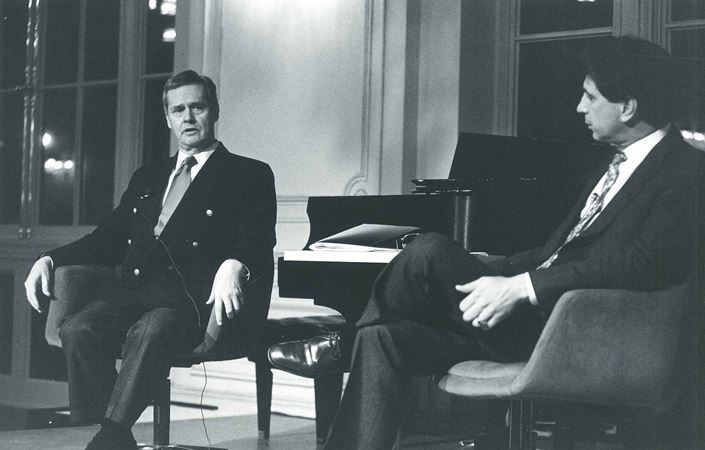
Photo: Ned Rorem and former CSO Composer-in-Residence John Corigliano give a pre-concert conversation in Orchestra Hall’s ballroom on November 8, 1990.
“The Silver Swan,” composed by Ned Rorem, is one of my favorite—and most hauntingly beautiful—pieces, especially in the performance by Karen Smith Emerson and Martin Katz. I first discovered this piece in 2019, and it has stayed with me ever since. Learning of Rorem’s passing in 2022 was sad.
Discovering that he studied in Paris for nine years under Arthur Honegger—and immersed himself in the vibrant postwar Parisian art scene—has been deeply inspirational. His engagement with the Parisian artistic milieu, meeting figures such as Poulenc, Milhaud, Auric, and Cocteau, has shown me how a composer can thrive at the intersection of music and broader cultural currents.
Rorem’s music, which spans over 500 songs, symphonies, operas, ballets, chamber works, and choral compositions, always resonates on a profoundly human level. The Silver Swan is a perfect example: a piece that keeps returning to me, revealing new depths with each listening. Time will let it sit, and perhaps that is the magic of Rorem’s art. As he once said, “I don’t believe that composers notate their moods, they don’t tell the music where to go—it leads them.”
Text:
The silver swan who, living, had no note,
when death approached, unlocked her silent throat.
Leaning her breast against the reedy shore,
thus sung her first and last, and sung no more:
"Farewell all joys, O death come close my eyes.
More geese than swans now live, more fools than wise.
Born in Richmond, Indiana, on October 23, 1923, Rorem began piano lessons at ten and discovered Maurice Ravel and Claude Debussy, an experience he said “changed my life forever.” He studied at Northwestern University, the Curtis Institute, and Juilliard, spending summers at Tanglewood under Aaron Copland. From 1949 to 1958, he lived in Paris, studying composition with Arthur Honegger and connecting with leading figures of the postwar European arts scene, which left a lasting impression on his music and approach to creativity.
His career was remarkable: he received a Pulitzer Prize in 1976 for Air Music, a GRAMMY Award in 1989, a Fulbright Fellowship, a Guggenheim Fellowship, multiple ASCAP-Deems Taylor Awards, and the Gold Medal in Music from the Academy of Arts and Letters, among many other honors. His compositions were commissioned by top institutions such as the New York Philharmonic, Chicago Symphony Orchestra, The Philadelphia Orchestra, and Carnegie Hall.
Remembering Rorem through “The Silver Swan” feels deeply personal and timeless—a piece that lingers long after the last note, guiding the listener through its haunting beauty.
Learn more about Ned Rorem:
Ned Rorem's official website: www.nedrorem.net


Comments